
Project Info
Type
Speculative Service Design
Role
Individual Project
Time
Dec 2025
Tools
Figma & Gemini 3
Project Overview
A speculative agricultural service system built for a future where radioactive contamination permanently alters the environment.
Speculative Scenario
Over the following decades, continuous wastewater discharge, climate change, and soil acidification have pushed global agriculture to collapse.Coastal farmland turned radioactive, crop species mutated, and food safety became humanity’s greatest uncertainty. More than half of the world’s arable land had been classified as “toxic zones”.
Research
Question
Faced with irreversible contamination, the question is no longer how to eliminate radiation, but how humans might live with it or to coexist, adapt, and regenerate.This leads to my research question:
How might we reimagine food systems to help humans regenerate and coexist with contaminated environments?
Design Process
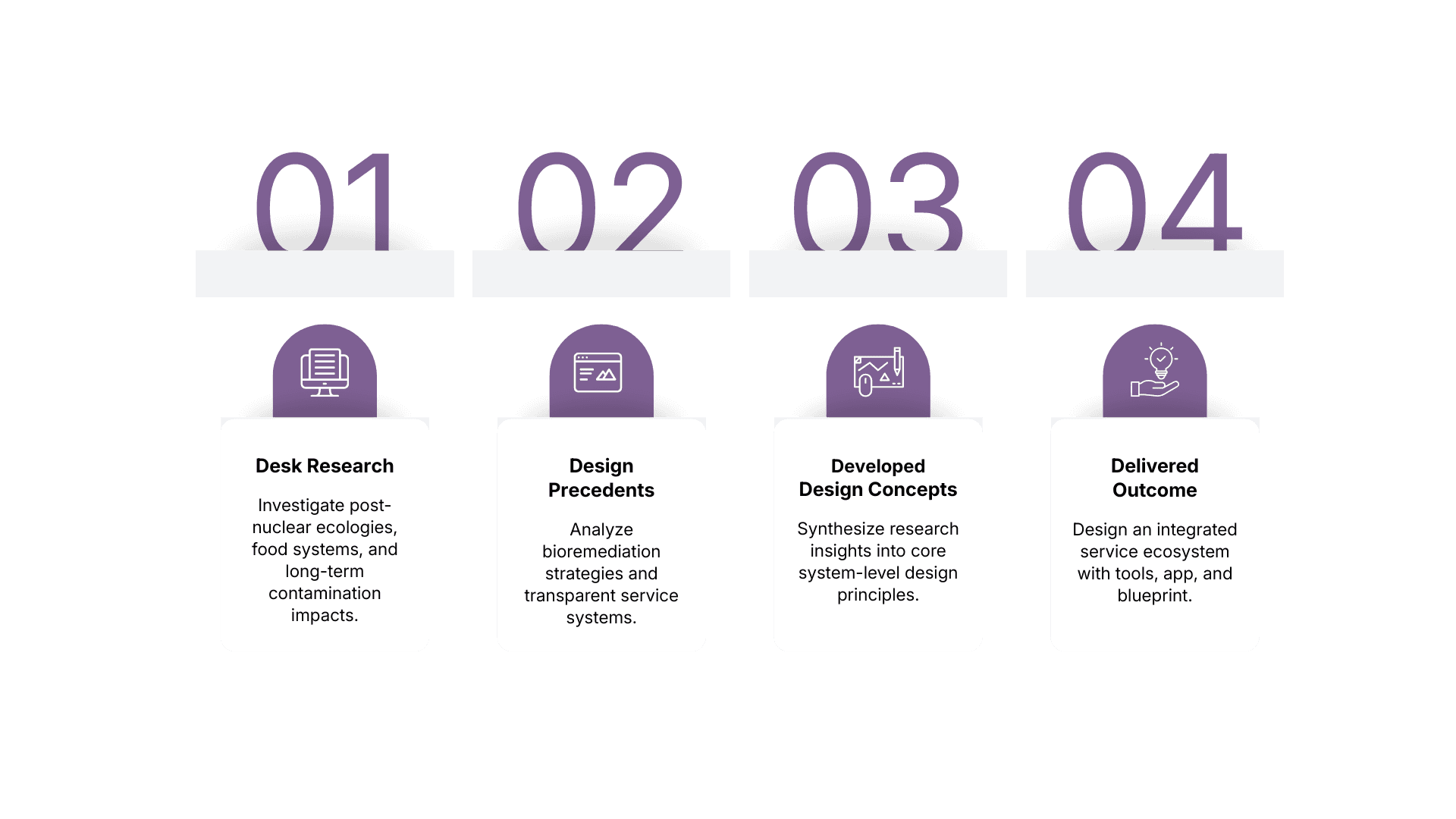
Let’s dive into Fallout Harvest step by step.
01 Desk Research
What I learned from case study research?
Chernobyl
The Chernobyl disaster in 1986 released massive amounts of radioactive materials into the environment, forcing thousands to evacuate.
Location
Ukraine
People
Around 116,000 residents were evacuated, creating a 30-km “exclusion zone.”

Insights
After the disaster, the land was not fully “restored,” but people learned how to live and farm carefully on contaminated land.
Scientists used plants to absorb radioactive substances and chose crops that were safer to grow.
Instead of expecting quick recovery, the focus shifted to long-term monitoring and gradual reuse of land.
Fukushima
In 2011, a 9.0 magnitude earthquake struck northeastern Japan, triggering a massive tsunami that severely damaged the Fukushima Daiichi Nuclear Power Plant. The disaster led to core meltdowns in three reactors and the release of radioactive materials into the air, soil, and ocean. Over 30,000 hectares of farmland were contaminated.
Location
Japan
People
150,000 residents were evacuated.

Insights
Food safety was rebuilt through constant soil testing and strict food inspection.
Every food product could be traced back to its land of origin, helping people understand where their food came from.
Clear data and transparency helped restore public trust in local agriculture.
What I learned from theories?
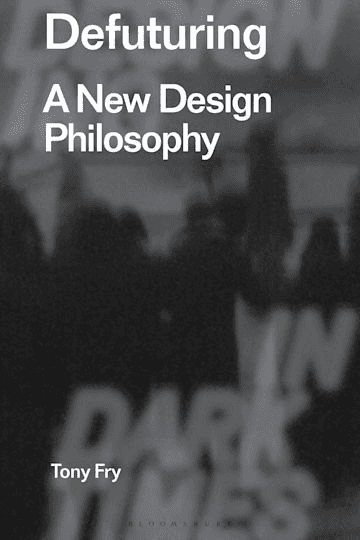
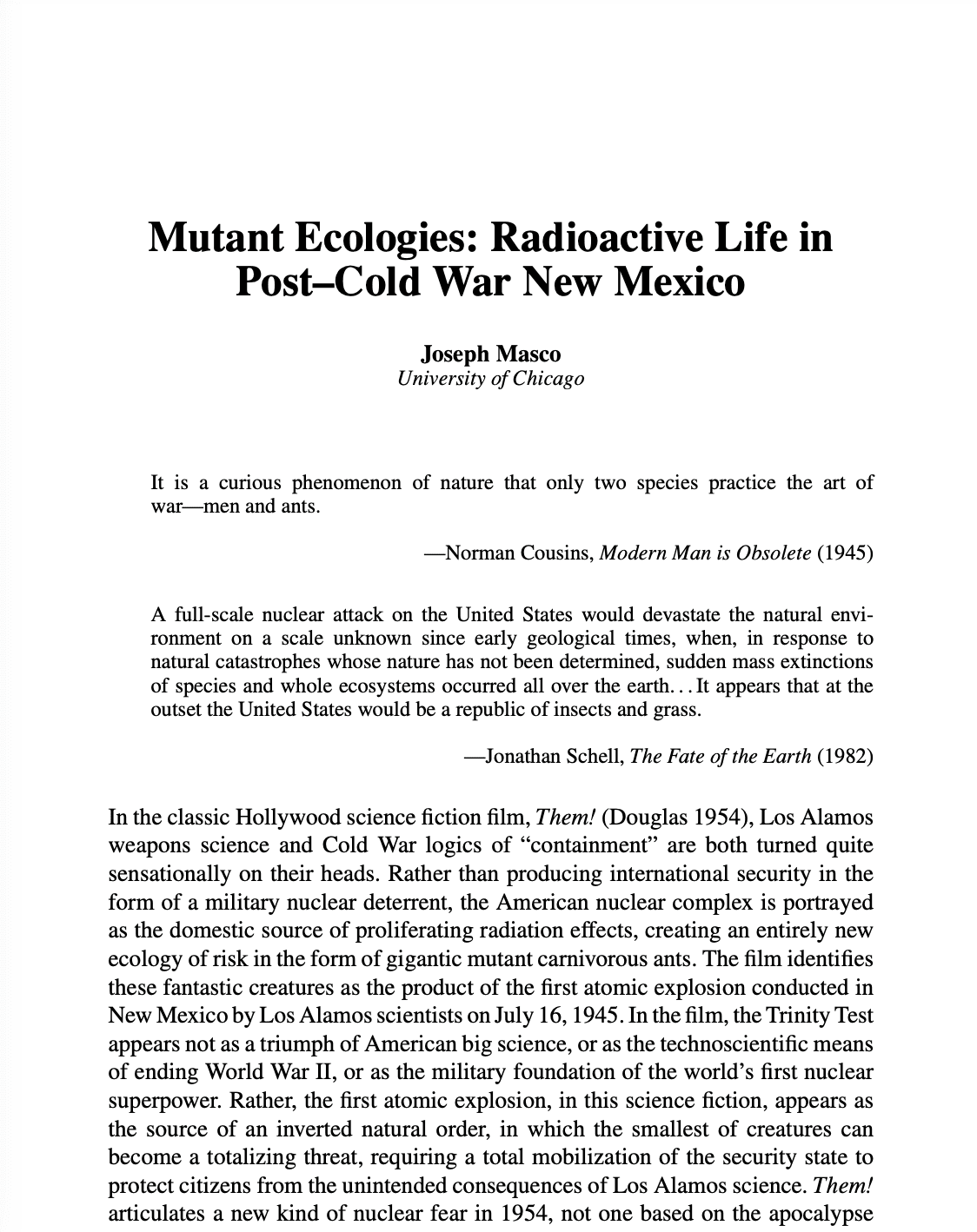
Tony Fry argues that traditional ideas of sustainability are often not enough.
Instead of preserving the same systems that caused environmental damage, design should focus on maintaining the basic conditions that allow life to continue over time, even in damaged environments.
Mutant ecology suggests that contamination is no longer a rare accident, but a normal condition shaping future ecosystems.
Plants, animals, and humans do not simply escape toxic environments—they adapt and evolve within them.
Defuturing
Mutant Ecology
Together, these ideas shift how we think about agriculture. Rather than trying to eliminate toxicity, agricultural systems must be designed to operate safely within contaminated conditions, supporting long-term coexistence between humans and land.
Summarized Key Learning from the Desk Research
01
02
03
04
Future design must care for damaged environments rather than replicate past systems.
Agriculture becomes a collaborative service system.
Long-term monitoring and data transparency is important.
Living organisms can act as ecological infrastructure.
How might we design an adaptive agricultural system that enables humans, ecological species, and data networks to sustain life on land permanently altered by radioactive contamination?
Design Question
In contaminated contexts, trust comes from transparency, not assumptions.
Recording each stage:testing, remediation, harvest to build accountability.
02 Design Precedents
To help answer my design question, I reviewed relevant design precedents and extracted key insights from both bioremediation practices and service design systems.
Bioremediation
Service Design


Sunflower Phytoremediation
Description
Insights
Sunflowers have been widely used in post-nuclear environments to absorb radioactive elements from contaminated soil and water.
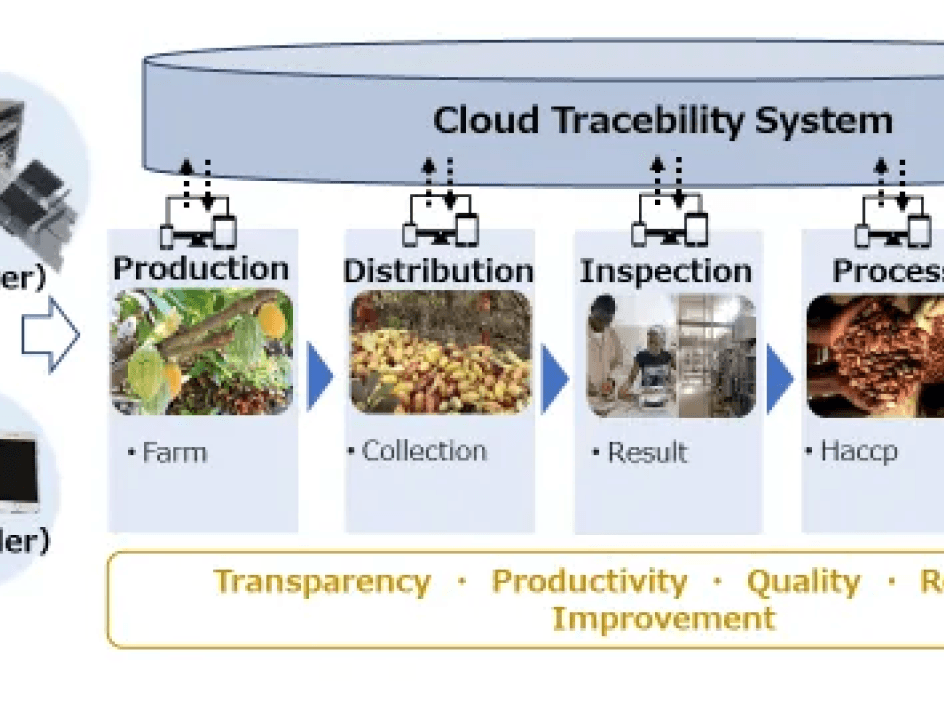
Japan’s food traceability system records every step of food production to ensure safety, quality, and origin transparency.
Safecast is a citizen-led platform that enables people to collect and share radiation data using simple sensing tools.
Plants can act as active remediation tools, not just agricultural crops.
Soil recovery happens in stages: planting → absorption → removal.
Ecological repair is slow and cyclical, not instant.
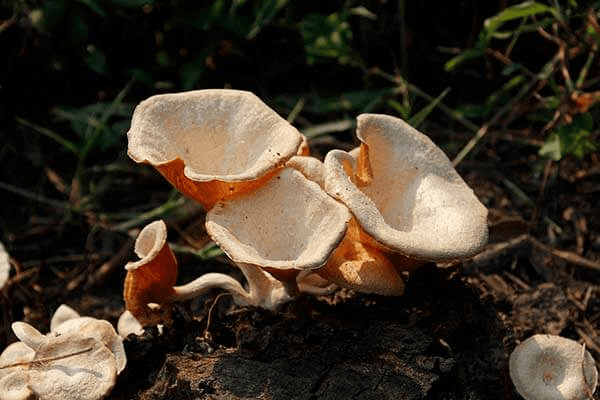
Fungi can function as first responders when land is too toxic for plants.
Remediation is not only absorption—toxins can be chemically decomposed.
Communities can generate reliable environmental data collectively.
Simple tools + open data increase public participation and trust.
Certain fungi can break down toxins and stabilize contaminated soil through underground mycelium networks.
Fungi Mycoremediation
Japan Food Traceability System
03 Developed Design Concepts
💡
Ecological Regeneration as a Multi-Stage Process
Soil recovery occurs in phases — fungi first stabilize land, followed by plants that absorb toxins, before food crops return.
Community-Driven Environmental Sensing
Environmental data is not centralized, but collectively produced and shared.
Transparent Traceability for Food Trust
Every food item carries its land history, remediation status, and safety record.


These concepts shaped the final system.
04 Delivered Design Outcome
The Fallout Harvest System
Based on these insights, I translated my research into a speculative service system designed to support agriculture in contaminated environments.
I begin by presenting the system loop of the Fallout Harvest service, which outlines how remediation, cultivation, verification, and community participation work together as a continuous cycle.
System Loop

Within this system, specific tools were designed to support key moments of interaction for different stakeholders.
Assessment Tool-Soil Pulse Rod (farmer-use-only)
The first tool, SoilPulse Rod, supports farmers during the remediation and cultivation stages by making soil conditions visible and actionable. Inspired by the clarity and simplicity of a thermometer, the tool reframes soil as a living system that can be “diagnosed.”
This dashboard allows farmers to monitor soil conditions and view a rendering prototype. The interface was generated using Google Gemini. Click the button to view the prototype and try out the simulation.
Sketch
Prototype

The farmer inserts the SoilPulse Rod directly into the ground. Once the sensor tip reaches the soil layer, the device begins reading underground conditions—detecting radiation levels, fungal activity, and soil health.


Food Scanner-Harvest Clip (consumer-use-only)
Fallout Harvest App
To extend this system to consumers, I designed the Harvest Clip—a small, everyday tool that allows people to verify food safety at the point of purchase.
A consumer picks up a packaged food item at a local market and clips the Harvest Clip onto the package.
The device scans the embedded traceability tag and immediately displays the food’s safety status through a soft light signal.
On the connected mobile app, the user can view detailed information about the land where the food was grown, including soil recovery stage, radiation level, and community trust score.
If the food is marked as safe, the user confirms the result. If not, they can flag it to inform the wider community.
Sketch
Use Case


The Harvest Clip mobile app serves as the digital companion to the Harvest Clip device, allowing consumers to verify food safety in a post-nuclear agricultural system.
The Harvest Clip app supports one focused user flow (see images below):
Scan → View Result → Explore Land Dossier → Mark Safe / Unsafe


Users can:
— Verify food safety
— Understand land remediation timelines
— Contribute feedback to a shared community map
The app turns consumers into active participants in ecological governance.
Service Blueprint
Finally, I mapped the entire service as a blueprint to show how farmers, consumers, tools, and data systems interact across different stages of the process.
How to read:
Read the blueprint from left to right to follow the lifecycle of the service—from soil remediation to cultivation, food verification, community contribution, and system feedback.
Each column represents a service stage, showing how actions and data flow over time.
Read vertically within each column to understand how the service is structured: Frontstage (User Actions), Backstage (System Actions), Support Processes and Physical Touchpoints

Conclusion
Together, these elements form an integrated service ecosystem that supports ecological recovery, food safety, and collective trust in a contaminated future.
If developed further, this project could evolve in several key directions:
I learned how to translate complex and abstract ecological challenges into clear interaction and service design systems.
I learned how speculative design can meaningfully contribute to sustainability by expanding how we imagine future conditions, not just future products.
I learned how to balance large-scale systems thinking with human-scale tools and interactions that feel accessible and grounded in everyday life.

What I Learned?
Next Step