
Project Info
Type
Digital Analytic
Role
Digital Analyst
Time
April 2026-May 2026
Client
Tools
Semrush, Similar Web, Claude Code
Team
Carol, Myra, Lanting, Anvita, Atharva
Digital Analytic Strategy for Alo Yoga
Meet Alo Yoga
Alo Yoga is a premium activewear and lifestyle brand built on the philosophy of spreading mindful movement. Known for its "studio-to-street" aesthetic, the brand has grown beyond professional-grade yoga gear into a full lifestyle ecosystem — spanning performance apparel, luxury loungewear, beauty products, and a digital wellness platform (Alo Moves).
On the surface, Alo looks like a brand that's winning. 5 million monthly organic visitors. 3.1 million Instagram followers. A cult following among yoga enthusiasts.
But beneath the surface, there's a different story.

Why Alo Needs Digital Analytics
Alo Yoga is growing — but not as fast as it could be. The data tells us three things:
01 The brand is invisible where it matters most.
Lululemon pulls in 17.5M monthly organic visits. Alo gets 5M. That's a 3.5x gap — not because the product is weaker, but because the digital strategy hasn't kept up.

02 Half the market doesn't know Alo exists.
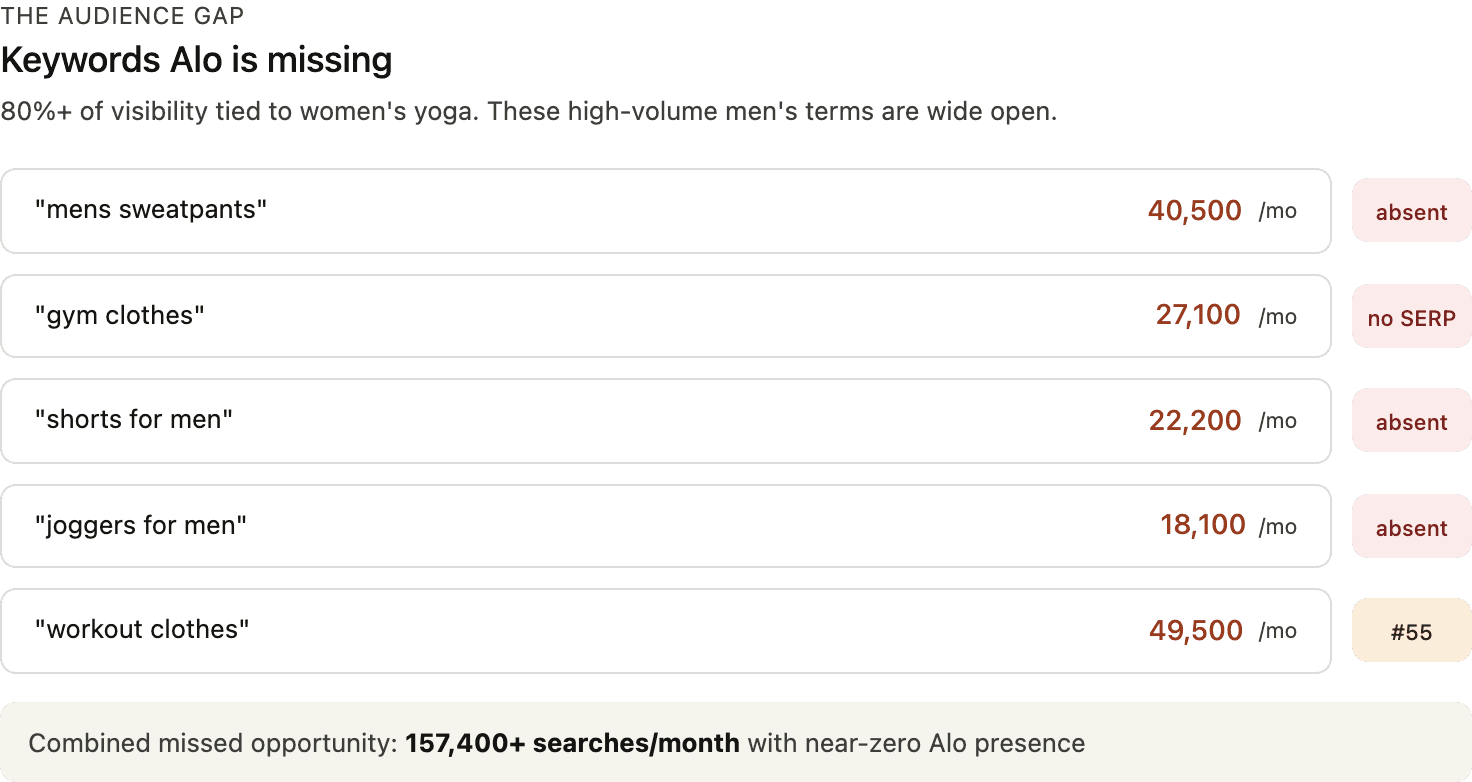
Over 80% of Alo's content and keyword visibility is tied to women's yoga. Men's activewear keywords like "mens sweatpants" (40,500 searches/month) and "gym clothes for men" remain almost entirely untapped.
03 Technical debt is silently killing performance.
Product and collection pages — the pages that actually drive revenue — are returning errors. The site's Lighthouse performance score is 17 out of 100 on desktop.

In a nutshell, Alo's problem is …
Alo Yoga’s digital infrastructure and SEO strategy are stuck in its 'Yoga-only' and “Women-only” legacy, creating a gap between its lifestyle vision and search visibility.
Competitor Analysis
This is a position map when Alo compare to other activewear brands. This chart maps each brand on two axes : sport breadth and gender balance.
Alo is alone in the yoga and female-focused zone. Other competitors have already expanded. Lululemon is going after runners, golfers, men.

Check more Competitors details on our slide deck!
Project Goal
Strategically expand Alo Yoga from a women-centric yoga brand into a comprehensive activewear lifestyle brand that serves a broader range of workout occasions and male consumers.

What we set out to solve?
Where exactly is Alo losing organic visibility, and why?
What keyword and content opportunities exist outside the yoga niche?How do Alo's social performance compare to competitors?Is Alo's social media strategy aligned with its growth ambitions?What would it take to make Alo visible to men and broader fitness audiences?
Down the Rabbit Hole-Methodology & My Role
We broke the investigation into 3 areas: SEO Audit, Keyword & Competitor Analysis and Social Analytics.

My Role
I analyzed Alo Yoga's off-page SEO:
I started with a simple question: Alo has 607K backlinks, is that actually good?
Rather than taking the number at face value, I used SEMrush Backlink Analytics to dig into the quality distribution behind it. I segmented referring domains by authority score to understand where the link equity was actually coming from, then mapped the anchor text landscape to see what signals those links were sending to search engines about Alo's brand identity.
I conducted the social media competitive analysis using SimilarWeb:
My approach was comparative, not just descriptive. I pulled social referral traffic and engagement data for Alo, Lululemon, and Gymshark side by side — not to rank them, but to understand how each brand was converting social presence into actual site traffic. I looked at which platforms were driving meaningful visits versus just generating impressions, and how content strategy differences across Instagram, TikTok, and YouTube mapped to those traffic patterns.
What We Found from the Data
Key Findings-SEO Audit
Off-Page SEO Finding
Alo's backlink profile is strong in size, but weak in quality and diversity.

Issue 1: 66% of referring domains are low authority.

Issue 2: 11% of backlinks use empty anchors.

Issue 3: Promotional anchors like “get the deal” and “save 30% off” make up a large portion of top anchors.
Recommendation
Alo should prioritize higher-authority backlinks from fitness, fashion, wellness, lifestyle, and media sites.
It should also guide partners and affiliates toward more descriptive anchor text.

Impact
Better backlink quality and anchor relevance would improve Alo’s ability to rank for priority non-branded keywords. This can increase domain authority, keyword visibility, and qualified organic traffic.
Why it matters:
Alo's backlink profile tells a contradictory story. The brand wants to be seen as a premium fitness lifestyle company, but its link ecosystem tells search engines something different. Two-thirds of referring domains are low authority, meaning most of Alo's link equity comes from sites Google doesn't trust. The 55,000 empty anchors are wasted signals, links that pass some authority but say nothing about what Alo actually sells. And the anchors that do carry text are overwhelmingly promotional: "get the deal," "shop now," "save 30% off." Taken together, Google doesn't see a premium activewear brand. It sees a discount storefront with weak endorsements. Until the backlink profile reflects the brand Alo is becoming — through high-authority placements and category-relevant anchor text — the site will keep struggling to rank for the exact terms it needs to own.
Key Findings-SEO Audit
On-Page SEO Finding
Alo’s web-pages lack clear titles, descriptions, headings, and sufficient content, weakening its ability to expand beyond a female yoga audience.

Issue 1: Multiple pages are missing meta descriptions

Issue 2: Multiple indexed pages are missing H1s

Issue 3: Multiple crawled pages had very shallow content depth
Recommendation
Alo should optimize its men's and unisex pages as a priority — rewrite titles and meta descriptions to include high-intent keywords like "men," "gym," and "workout," and ensure every indexable page has a clear, search-aligned H1 (e.g., "Men's Workout Clothes" instead of vague campaign language). At the same time, enrich these pages with meaningful content — fit guides, fabric details, styling suggestions — to give both users and search engines a reason to take them seriously. These aren't just SEO fixes; they're the digital foundation for Alo's audience expansion strategy.


Impact
These changes work together to close the gap between where Alo's brand is heading and what search engines currently see. Optimized titles, H1s, and richer content make men's and unisex pages discoverable for the high-intent searches Alo is currently missing — while giving users the depth and clarity they need to trust a premium purchase. The result is stronger rankings, broader audience reach, and a digital presence that finally matches Alo's ambition to be more than a women's yoga brand.
Why it matters:
Alo is investing in expanding into men's and broader fitness categories — but the website's on-page structure isn't ready to support that shift. When 36% of pages have no meta description, nearly half are missing an H1, and over a third have fewer than 200 words of content, search engines have no clear signal about what those pages are for or who they're meant to serve. It doesn't matter if Alo launches a men's collection or a gym wear line — if the pages can't communicate their purpose to Google, they won't rank, and the target audience will never find them. These aren't cosmetic issues; they're the reason Alo's category expansion stays invisible in search results while Lululemon captures the traffic.
Key Findings-SEO Audit
Technical SEO Finding
Alo's website fails Core Web Vitals on both desktop and mobile — with a Lighthouse performance score of just 17/100 — meaning Google is actively penalizing the site's rankings while slow load times drive potential customers away before they ever see a product.
Issues: Google uses Core Web Vitals (CWV) to measure how users experience the speed, responsiveness, and visual stability of a page. Pages that fail these metrics are penalized in the rankings


Desktop Lighthouse Score
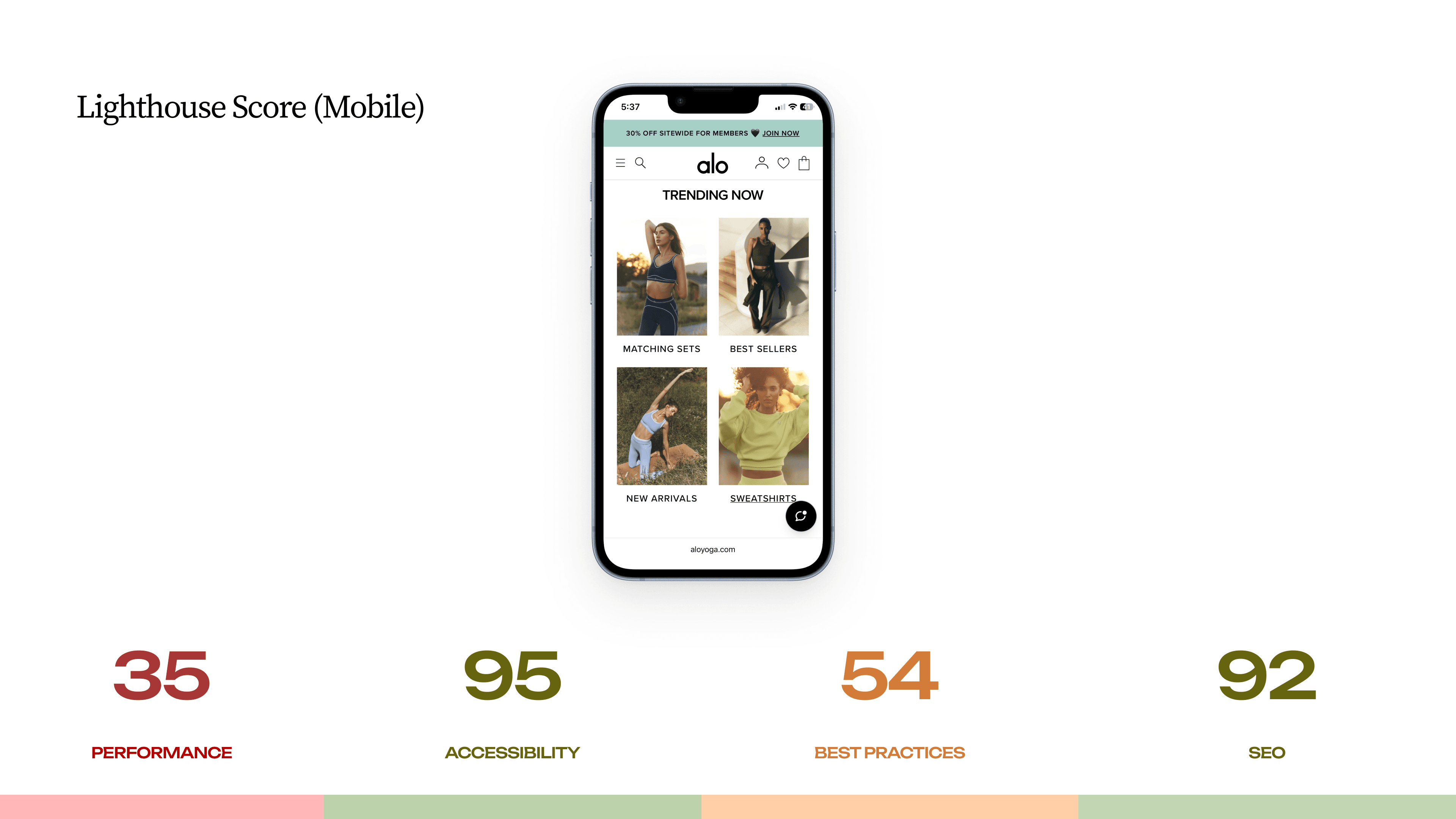
Mobile Lighthouse Score
Recommendation
For JS & Playoads, reduce unused JavaScript and compress assets to lower the 24 MB payload. Break up long main-thread tasks to improve mobile responsiveness (INP).
For CLS (stability), ensure all images and video elements have defined `width` and `height` attributes in the HTML.
For Accessibility, fix buttons and links that lack discernible names, and correct heading structures to improve the accessibility scores.
Impact
By improving the core web vitals, pages load faster and feel more stable. This also ensures Alo isn’t penalized by Google’s ranking systems for poor speed and layout stability
Why it matters:
For a brand selling $100+ leggings, every second of load time costs conversions. Alo's site takes 15–19 seconds just to execute JavaScript, and the 24 MB payload means users — especially on mobile — are waiting instead of shopping. This isn't just a technical problem; it's a revenue problem. Google confirms it by failing Alo on Core Web Vitals on both platforms, which directly suppresses rankings. Alo could have the best product pages and keyword strategy in the market, but if the site can't load fast enough to keep users engaged, none of that work converts into traffic or sales.
Check more SEO Findings and details on our slide deck!
Key Findings-Keyword Research
Keywords Findings
80% of Alo's content and search visibility is tied to female yoga
Issues
Keyword gap analysis revealed that Alo has untapped opportunities in men’s activewear search terms, including:
“mens sweatpants”
“mens shorts”
“gym workout clothes for men”
“mens workout clothes”
“mens athletic wear”
“mens gym clothes”
Men’s category keywords were either absent, weakly targeted, or not fully supported by optimized content and category page strategy.
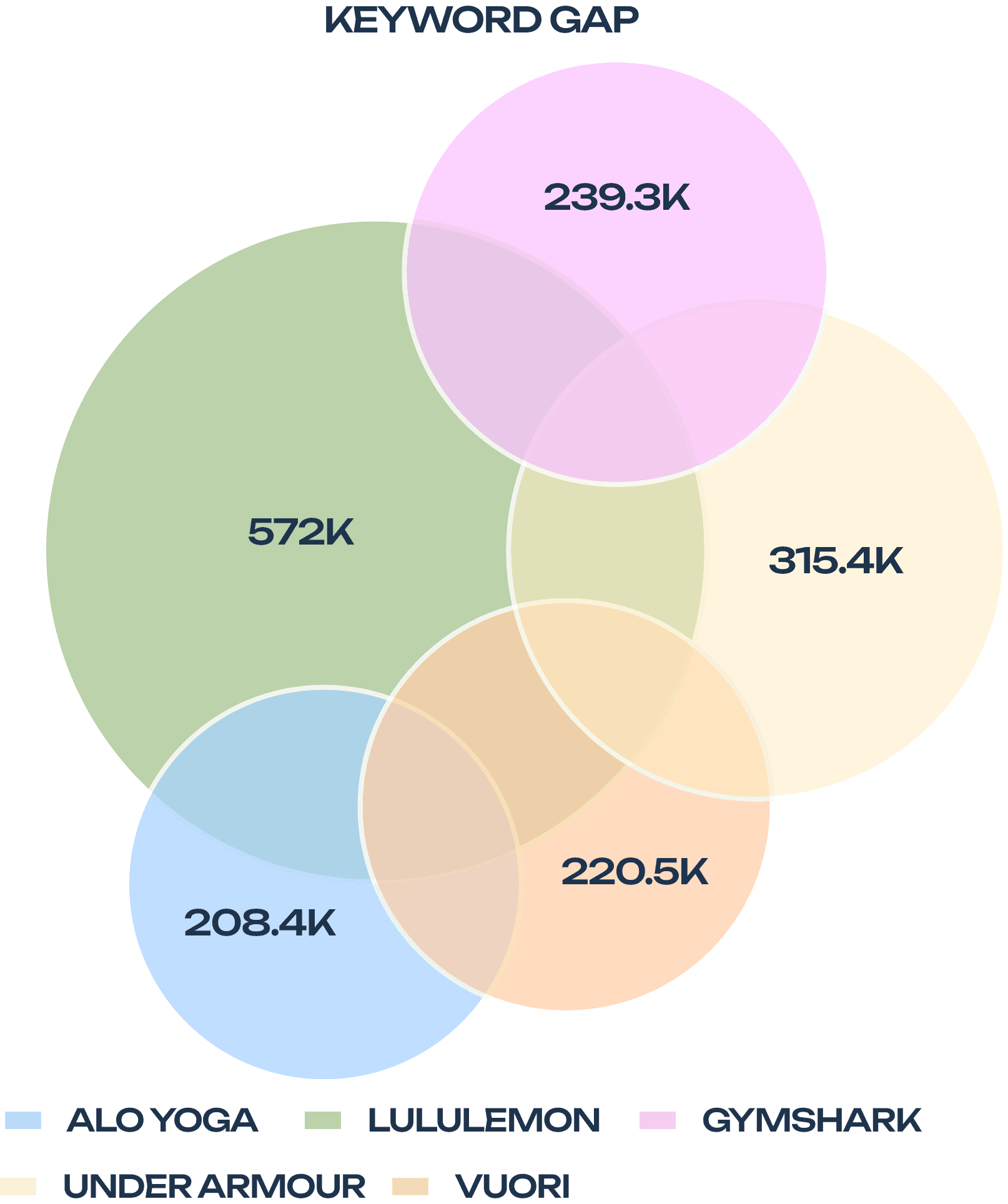
Data from Semrush
Recommendation
Alo should utilize their men’s activewear landing pages and supporting content clusters around terms like: “men’s workout clothes,” “men’s sweatpants,” “men’s gym shorts,” and “gym workout clothes for men.”

Impact
Alo’s target audience expands beyond a women-centric yoga niche. Interest from more potential buyers = more revenue
Convert new male customers who are already searching with purchase intent.
Increase non-branded organic traffic.
Improve visibility in the men’s activewear category
Why it matters:
These are high-intent search terms. Users searching for “mens sweatpants” or “gym workout clothes for men” are already close to product discovery or purchase. If Alo is not visible for these searches, competitors capture the traffic and conversion opportunity.
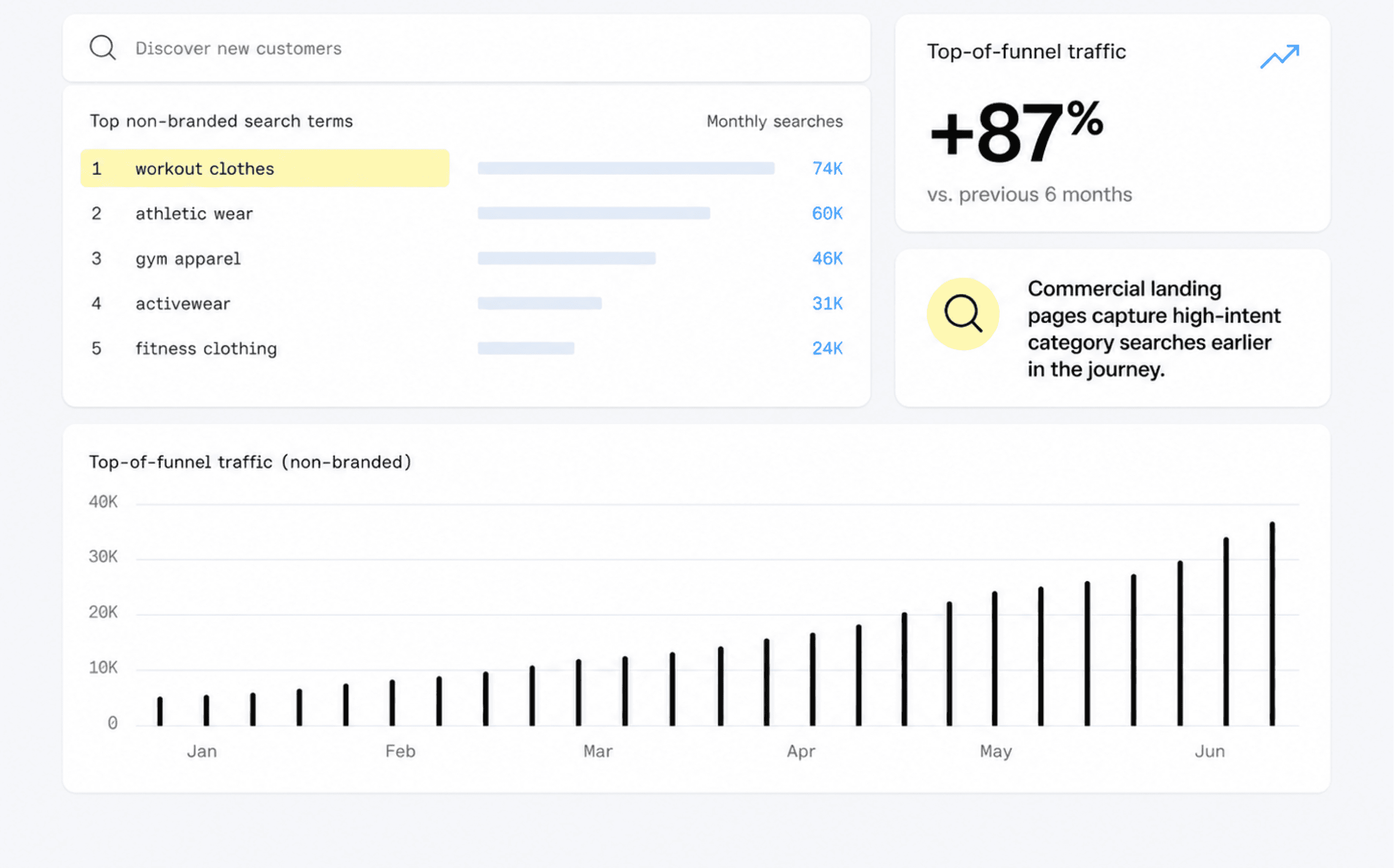
Alo is missing broader workout-related search demand beyond yoga.
Issues
Alo performs well for “yoga clothes,” ranking 4th, but performs much weaker for broader activewear terms. For example, Alo ranks 55th for “workout clothes”, and for “gym clothes,” Alo does not have a SERP feature.
Underrepresented broader high-volume terms include:
“gym clothes”
“workout clothes”
“athletic wear”
“running clothes”
“training clothes”
“athleisure wear”

Keyword: Yoga (data from Semrush)
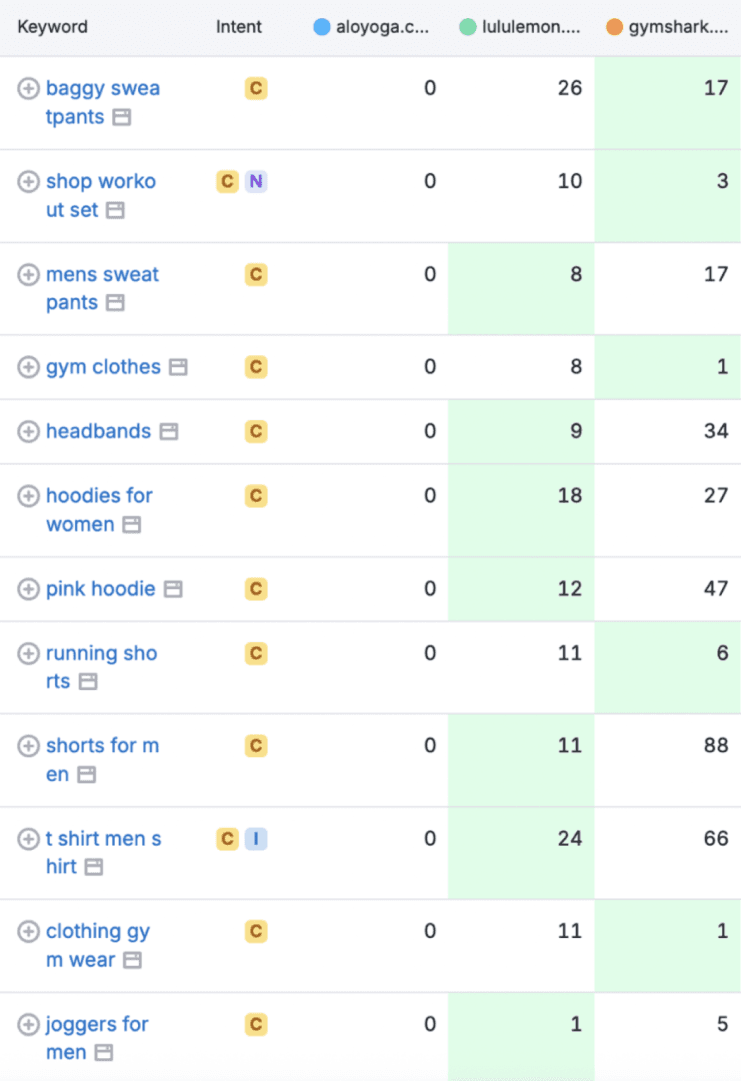
Keyword comparison for other activewear terms (vs. lululemon and gymshark)
Recommendation
Alo should maintain its yoga authority while making sure that its broader category pages for “workout clothes,” “gym clothes,” “athletic wear,” and “sports bras.” are optimized as commercial landing pages with strategic key words, not just product grids.

Impact
Alo improves its discoverability from being mainly a yoga brand to being found as a full activewear and lifestyle brand.
Better competitive positioning against top competitors.
Stronger category visibility
More top-of-funnel traffic
Why it matters:
These broader terms represent a major growth opportunity. If Alo wants to be perceived as a comprehensive activewear lifestyle brand, it needs to show up when users search for workout occasions beyond yoga.
Check more Keywords Findings and details on our slide deck!
Alo's Overall Social Findings
Alo has the smallest social-driven traffic among the three brands (Lululemon, Gymshark), with a niche presence focused on yoga and women, while competitors reach broader fitness audiences.
Total Traffic Landscape (Alo vs Lululemon vs Gymshark)
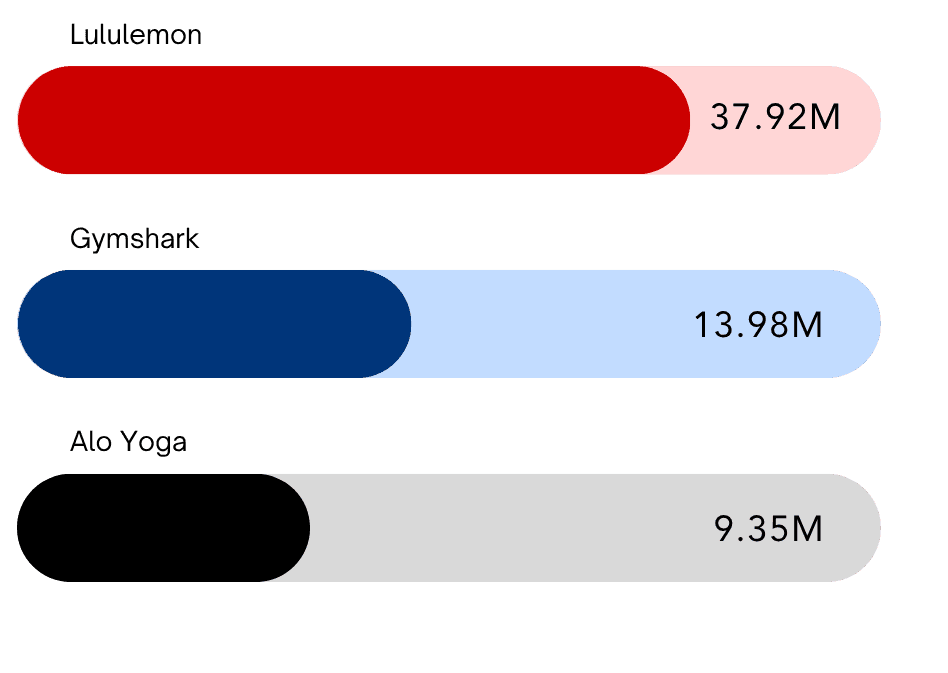
Here's the website traffic landscape across the three brands in March 2026. Lululemon leads at 37.92 million monthly visits. Gymshark is at 13.98 million. Alo is at 9.35 million — about a quarter of Lululemon's volume. The trend chart (traffic over time) shows this gap has been consistent throughout the first quarter of 2026
Monthly Visits (March 2026)

Traffic Over Time (Jan–Mar 2026)
Socail Traffic Landscape (Alo vs Lululemon vs Gymshark)
The top bar shows that of all social-driven traffic across the three brands, Lululemon captures 66%, Gymshark 21%, and Alo just 12%. Below that, we can see how each brand's social traffic distributes — Alo leads on Instagram at 17%, Gymshark dominates YouTube at 55%, and the three brands take very different paths to reach their audiences.

Total Social Traffic Share & Social Channel Share
Findings from Similar Web Data
Finding 1 Alo Captures the Smallest Share of Social-Driven Traffic
Alo accounts for 12.40% of competitive social traffic share (1.33M visits), trailing Lululemon's 66.45% (4.72M) and Gymshark's 21.16% (2.44M) over the three-month period.
Hence, Alo isn't just behind the leader — it's also behind a much smaller, younger brand like Gymshark in terms of social pull. For a brand whose strategic goal is to reach new audiences — men, gym-goers, broader fitness — social is exactly where that discovery would happen. And right now, that discovery channel is the weakest of the three.

Total Social Traffic and Total Social Visits( 3mo)
Finding 2 Alo's Site Engagement Is Competitive: The Problem Is Getting Users There
Once users land on Alo's site, they behave well — bounce rate (36%) and pages per visit (5.08) are nearly identical to Lululemon's. The problem isn't what happens on the site; it's how few people are getting there in the first place.
This shifts the whole conversation toward acquisition channels — search, social, and PR — rather than the website itself.

Finding 3 TikTok Tells a Different Story: Alo Holds the Largest Referring Share Among the Three
One outlier worth highlighting: TikTok. While TikTok overall accounts for only 0.10% of total referring traffic — small in absolute terms — within that pool, Alo holds 65% share, ahead of Lululemon at 33% and Gymshark which is barely present.
This is actually the one channel where Alo leads the competitive set. Given that TikTok is heavily skewed toward younger, more unisex audiences — exactly the kind of audience Alo needs to reach for its expansion goal — this is a signal worth investing in early.

Tiktok channel share
Findings from Alo's Social Media Accounts Data
Alo’s social strategy has not evolved alongside its broader audience expansion goals. Compared to its competitors, Alo lacks a clear cross-platform content strategy and differentiated audience targeting.
YouTube
Alo’s YouTube is overly focused on yoga content, despite offering broader fitness content through Alo Wellness Club. This limits its ability to reach gym-focused and male audiences.

Alo uses multiple Instagram accounts (e.g., @alo, @alomen), but often posts the same campaigns and captions across them. This duplication reduces content differentiation and weakens the purpose of segmentation.

TikTok
Alo’s TikTok is more casual and unisex, but men’s content is often duplicated from other platforms, limiting differentiation. This limits Alo’s ability to reach new audiences and build a premium fitness lifestyle brand image.

Recommendation
Give each social media platform a clearer role instead of reposting the same content everywhere.
Include more gym, fitness, lifestyle, and men’s content to support its broader audience expansion goals.
TikTok gives Alo more opportunities to test trends, creator-led content, and community-driven engagement.
Impact
Giving each platform a distinct role — YouTube for full-spectrum fitness content, TikTok for trend-driven and creator-led engagement, Instagram for brand storytelling — turns three fragmented feeds into a unified acquisition engine. Adding gym, fitness, and men's content consistently across channels makes Alo discoverable to the audiences it's trying to reach, while leaning into TikTok's unisex, younger demographic capitalizes on the one platform where Alo already outperforms. The shift from "post everywhere" to "purpose everywhere" means social stops being a branding exercise and starts driving measurable site traffic and new audience growth.

Why it matters:
The men, gym-goers, and broader fitness audiences Alo wants to reach are already on these platforms — but Alo's fragmented content strategy means they never see a consistent message about what the brand actually offers beyond yoga. The irony is that TikTok, the one channel where Alo leads at 65% referring share, skews toward exactly the younger, unisex audience Alo needs — yet it remains the least invested channel. Until social becomes a deliberate acquisition tool rather than a content dump, Alo's audience expansion stays a product strategy without a discovery engine
Check more Social Media Findings and details on our slide deck!
Proposed Digital Strategy for Alo Yoga's Expansion Goal (Solution)
01 We built a Web Performance Dashboard for tracking metrics and progress over time.
Check our interactive dashboard
We use claude code and vercel to build this dashboard
Why we build this dashboard?
Alo's challenge isn't just fixing SEO or posting more on social — it's a full repositioning from a women's yoga brand to a premium fitness lifestyle brand. That shift touches every channel: search, social, content, and backlinks. We needed a single place to track whether the strategy is actually working — are new audiences finding Alo, are they engaging, and are they converting? This dashboard connects acquisition, engagement, and conversion metrics to one strategic question: is Alo's digital presence catching up to where the brand is heading?
02 Recommendations from data and findings shift to the final strategic solution
Strategic Recommendations: Reposition Alo from a women's yoga brand into a premium fitness lifestyle brand — across search, content, and social.
Our recommendations follow a three-phase roadmap — each phase builds on the last. First, fix the technical foundation so Google can actually see Alo's pages. Then, expand keyword coverage and content into the men's and fitness categories Alo is currently invisible in. Finally, reshape how the broader market perceives the brand through high-authority backlinks, unified social storytelling, and strategic paid investment. The logic is simple: you can't rank for what Google can't crawl, and you can't reposition a brand that search engines still think is a yoga-only company.

My Individual Contribution of this Project
I analyzed Alo's backlink profile to understand how the internet perceives the brand.
My approach to off-page SEO wasn't just "count the links." I used SEMrush Backlink Analytics to look at quality distribution — segmenting 14K referring domains by authority score to see where the link equity was actually coming from. Then I mapped the anchor text landscape, not as an SEO checklist, but to answer a positioning question: what do these links tell Google about what Alo is? The answer was revealing — search engines associated Alo with discount promotions ("get the deal," "save 30% off"), not with product categories or fitness identity. That insight became the bridge between a technical metric and the brand repositioning strategy.

I benchmarked Alo's social performance against competitors through SimilarWeb.
I pulled social referral traffic for Alo, Lululemon, and Gymshark,no t to rank them, but to understand how each brand converts social presence into site traffic. The comparison was deliberate: I looked at which platforms were driving real visits versus just impressions, and how content strategy differences mapped to those traffic patterns. The most important finding wasn't a number, it was a structural observation. Lululemon adapted one story to three platforms; Alo ran three disconnected calendars. That reframed our social recommendation from "post more content" to "unify the narrative."

Conclusion
What's Next for Alo?
Alo doesn't have a brand problem — it has a discoverability problem. The product is premium, the community is loyal, and the lifestyle positioning is strong. But search engines see Alo as a yoga brand for women, and the technical foundation isn't strong enough to support the brand's growth ambitions.
The path forward is clear: fix the technical debt, expand keyword coverage into men's and broader fitness categories, enrich page content, earn stronger backlinks, and unify the social voice. This isn't a pivot — it's an evolution.
My Key Takeaway
What I Learned: Brand perception and search perception are two different things — and the gap between them is where the real opportunity lives. Alo is already evolving its product line, launching trail shoes and collaborating with male athletes. But the digital footprint hasn't caught up. Analytics revealed a brand moving in one direction while its entire search and social ecosystem still pointed the other way.
What Surprised Me: How much the backlink anchor text told us about brand identity. I expected the off-page analysis to be about link quality and domain authority — technical SEO metrics. Instead, it became a mirror of how the internet sees Alo. When your most common anchors are "get the deal" and "shop now," Google isn't building a picture of a premium fitness brand. That connection between a seemingly technical metric and a strategic positioning problem was the most unexpected insight of the project.
How this project improved my analytics skills: This project taught me how to do SEO audit and Social Analysis. Before this project, I thought these two are separate things, now I know that I should read them as one connected system: where backlink anchors inform brand positioning, keyword gaps reveal audience blind spots, and social traffic patterns expose content strategy failures. I also learned that the most valuable insight isn't always in the biggest number; sometimes it's in the pattern you notice when you zoom out and ask why the data looks the way it does.

Thanks to our Team

Special thanks to our Prof Sahirah
Key Findings-Social Analysis
Social Media Findings