
Project Info
Type
Service Design
Client
Pratt's Office of Reseach and Strategic Partnerships
Role
Service Design Consultant
Time
Oct 2025-Dec 2025
Tools
Figma
Team
Carol B, Roshini G, Merlyn K, Rutuja N
Designing Clearer Research Support at Pratt
Project Overview
A service design project exploring how Pratt’s Office of Research and Strategic Partnerships can improve communication and support for diverse faculty throughout the research development journey.
Introducing the Client: ORSP (Office of Research and Strategic Partnerships)
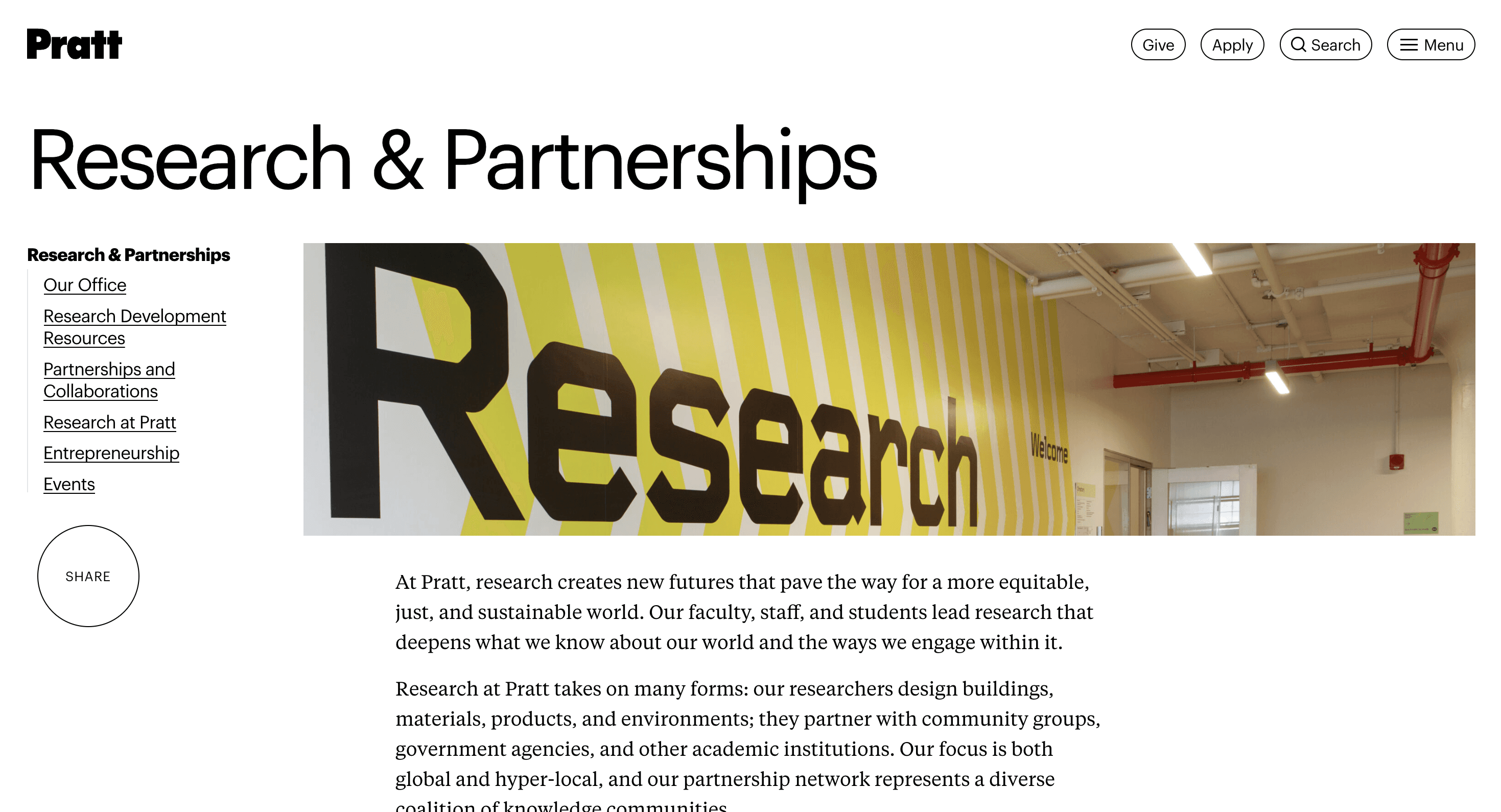
ORSP (Office of Research and Strategic Partnerships), is Pratt’s central support service for faculty research.
ORSP works closely with faculty, administrators, and external partners to help researchers navigate funding opportunities, compliance requirements, budgeting, and institutional processes.
Understanding the Problem Space
A service design project exploring how Pratt’s Office of Research and Strategic Partnerships can improve communication and support for diverse faculty throughout the research development journey.
The Challenge
Complex and unclear research development processes
Faculty struggle to understand the sequence of steps, key contacts, and how to navigate ORSP’s research processes.
One-size-fits-all communication for diverse faculty needs
ORSP’s communication does not reflect the varied experience levels, disciplines, and working styles of Pratt faculty.
Improve communication from ORSP to faculty, defining the order of events to make it easier for faculty to achieve their research goals through ORSP’s procedures and resources.
Define archetypes and how to use them to help improve our support of Pratt faculty in future instances.
Service Blueprint: How ORSP offer the research support service?
Our service blueprint maps the end-to-end research support journey at Pratt, focusing on how faculty interact with ORSP across different stages of research development. It brings together insights from our service safari, co-design workshops, and collaborative sessions with ORSP staff to visualize both the faculty experience and ORSP’s internal workflows.
By capturing frontstage interactions and backstage processes in one view, the blueprint reveals where communication breaks down, where support is effective, and where targeted interventions can create the most impact.
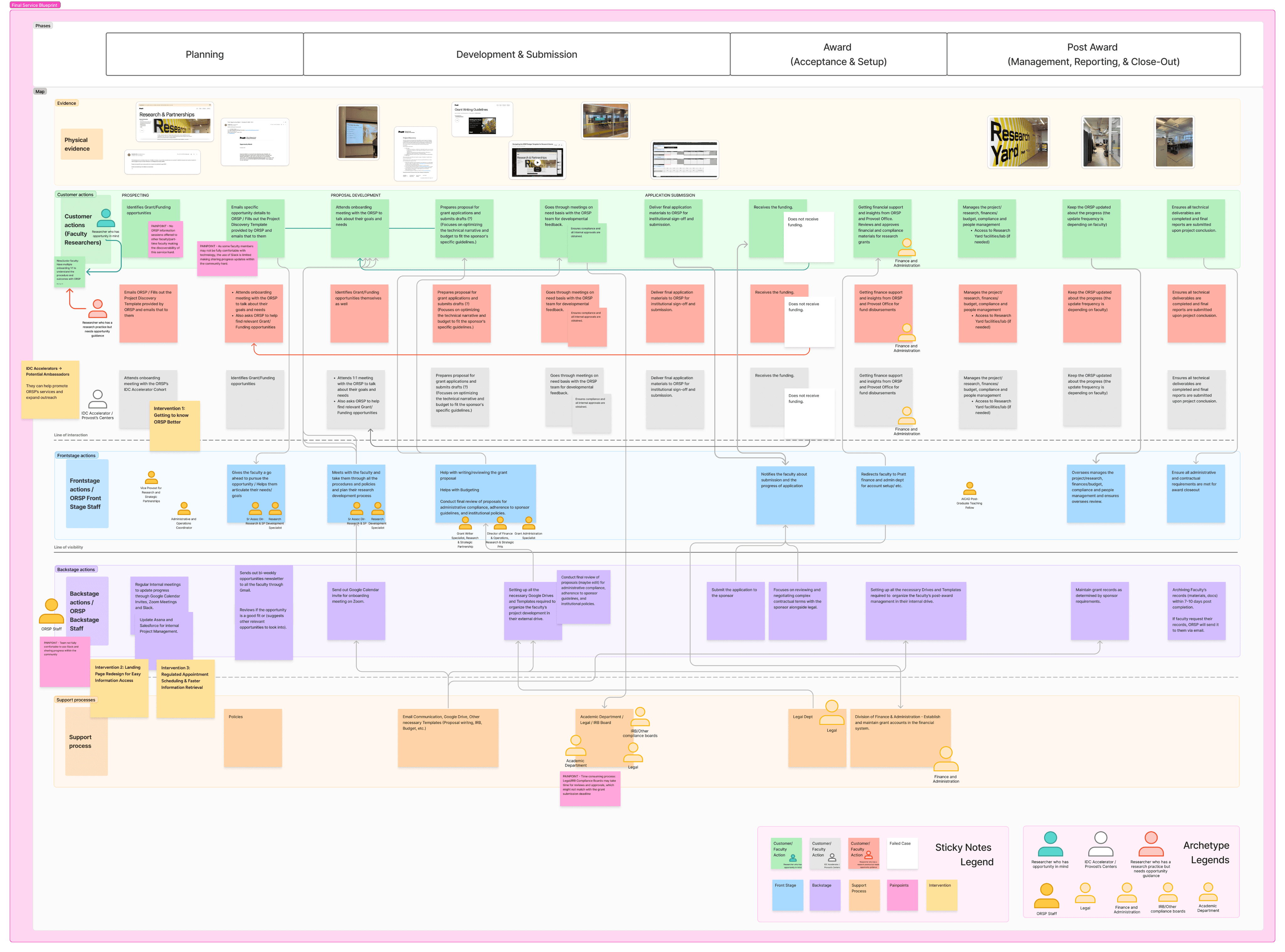
ORSP Service Blueprint Link→
What is service blueprint?
How to read the blueprint?
Ecosystem Loop: Value Exchange in the ORSP-Faculty Ecosystem
How to understand the Ecosystem Loop?
Think of Pratt’s research ecosystem as a network of people and departments that constantly exchange value with one another to make research possible.
Value Exchange
Faculty contribute research and innovation → ORSP provides support and coordination.
Institutional Units include IRB, Finance, Legal and Provost Office. Institutional Units providing compliance and approvals, ORSP will translate those requirements into clear guidance for faculty.

Our Research Process
Observing ORSP in Action

Observation Activities
Through a series of observation activities and conversations with ORSP staff, we conducted a service safari to understand how research support currently operates in practice.
These observations were then mapped and framed to capture the existing service experience, laying the foundation for identifying communication gaps and improvement opportunities.
What is Co-design workshop?
Inside the Co-design Workshop

A faculty member was working on his researcher persona
Workshop Goals
Understand how faculty define their research personalities at Pratt.
Identify the challenges and needs at each stage of the research development.
Co-create ideas for better communication experience with ORSP in the future.
Inside the Co-design Workshop

Participants Demographics
Building on our service safari observations, we conducted a series of co-design workshops with Pratt faculty to better understand their research experiences and communication needs. Our team conducted a series of 4 co-design workshops with 6 faculty members from different schools and disciplines, followed by a collaboration session with the ORSP team.
Activity 1 Research Persona Mapping

Two faculty members were working their "brain" template

Activity 1 Materials (prompts and templates)
This activity was designed to help faculty reflect on and articulate their identities as researchers by selecting, completing, and arranging prompt cards within a blank “brain” template, allowing them to visually map and share how they understand their research roles, motivations, and working styles. Setting the foundation for the following activity.
Activity 2 Research Journey Co-creation

Faculty think aloud as they reflect on their research journeys.

Activity 2 Research journey template
This activity aimed to uncover faculty needs, challenges, and support preferences across the research development process by guiding participants through a scenario-based reflection and having them map experiences, pain points, and ideas for improvement at each stage of a structured research journey.
Research Process
Step 3: Synthesis & Key Insights

01
Lack of Awareness & Difficulty in Navigating Pratt’s available Institutional Resources for Research Development Support

02
Need for Enhanced Guidance in Positioning Art-Based and Intersectional Research Work and Outcomes Within Formal Research Frameworks
03
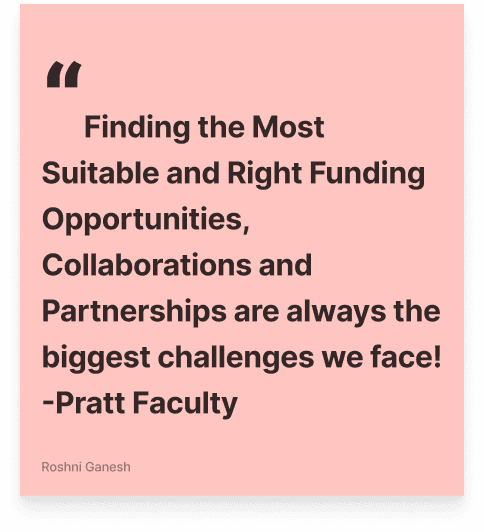
Difficulty Identifying Collaborative Partners and
Navigating Funding Opportunities

04
Need for more simplified budgeting tools and Enhanced Support for other Administrative Tasks

05
Desire for stronger institutional recognition, acknowledgement and increased visibility of their research contributions
Project Outcome-Making Sense of What We Heard
What is Archetype?
We identified 6 faculty archetypes (display in slide show).


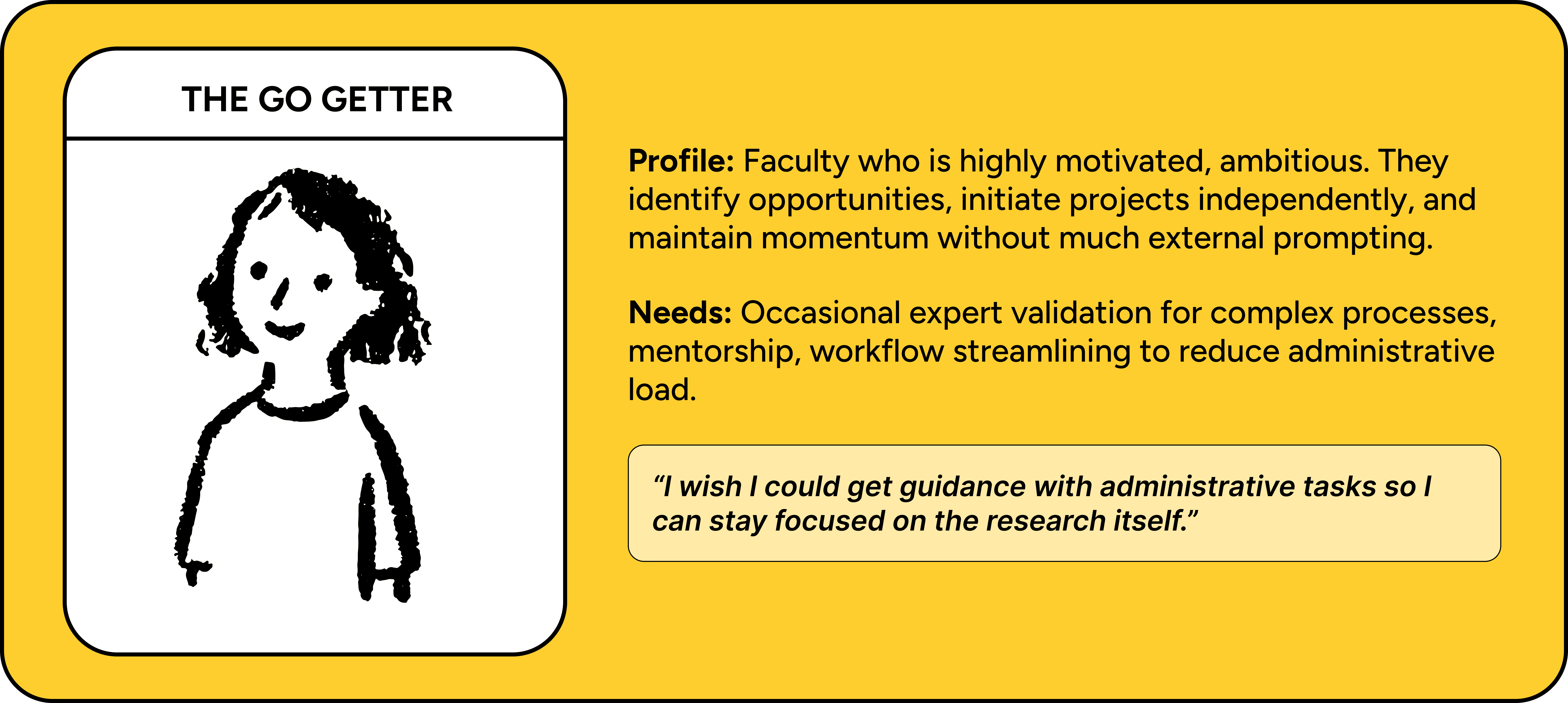
Faculty Archetypes

Intervention Design Process Map
Before arriving at these final interventions, our ideas went through several rounds of iteration, validation, and refinement. The following process map illustrates how insights from our workshops and collaborations evolved into the final intervention themes.
My Role: Design Interventions were co-developed; I led the concept development and prototyping for Intervention 2.
Project Outcome
Intervention 1: Getting to Know ORSP (Better)
What is it?
Insights Connection
Event 1: ORSP Resource Fair
A semesterly institute-wide resource fair style event to increase faculty awareness and understanding of ORSP’s research support services.
How this event works?

1
The event is structured around a series of resource tables, each aligned with a key stage of the research development process. Every table is facilitated by specific ORSP staff members, allowing faculty to receive direct, stage-specific guidance tailored to their needs.
2
To support the event, we developed a comprehensive toolkit that includes editable promotional flyers, an ORSP 101 one-pager, and ORSP staff role cards to help faculty quickly understand available resources and points of contact.
Staff Role Cards Link →
ORSP 101 Link →
Event(s) Posters Link →
Simplified Project Discovery Form Link →
Why this event matters?
Recognize and celebrate the achievements of IDC Accelerator participants.
Encourage departments to share and document ongoing research.
Create more visibility for ORSP’s role in supporting research development.
Foster a research culture that encourages collaboration, mentorship, and innovation.
Connect to archetypes:
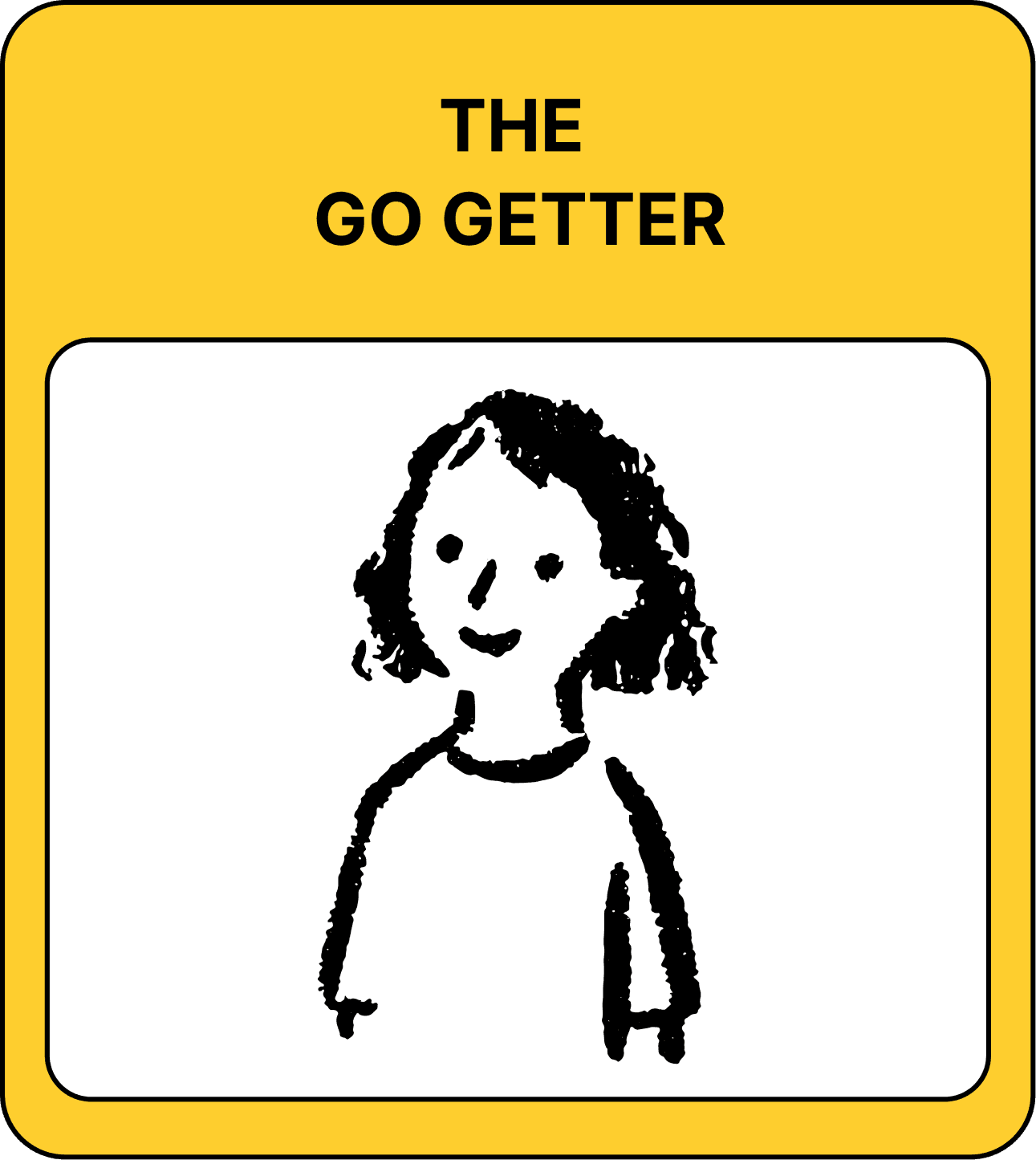
It primarily targets the New to Pratt and Research Newbie archetypes, as well as the Go-Getter archetype, who requires additional guidance and information.


Event 2: IDC Accelerator Ambassadors - Departmental Research Showcase Series
A recurring or annual Research Showcase hosted within each department, where IDC Accelerator alumni present their research journey and outcomes.
How this event works?

Why this event matters?
Involved Stakeholders
Connect to archetypes:
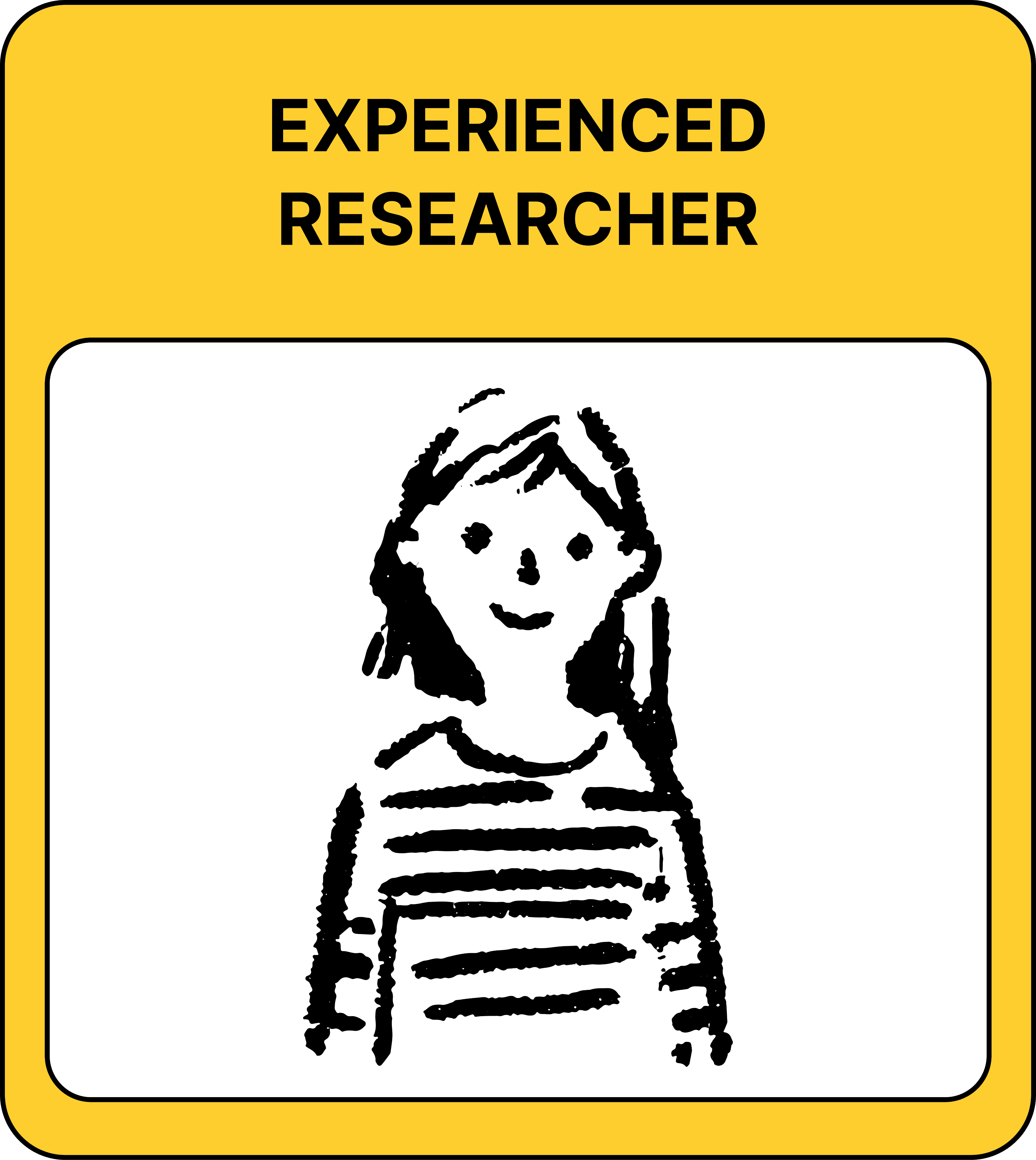
It supports the Partnership Guy and The Practitioner archetypes.


Project Outcome
Intervention 2: Landing Page Redesign for Easy Information Access
What is it?
Insights Connection
How the landing page redesign?

01 Prominent CTA Buttons
Introduce clear, prominent Call-to-Action buttons based on common research activities so faculty can immediately choose what they want to do (mock-up highlight section)
Personalized the website experience for different faculty types.

02 Structure Step-by-Step Guide
The redesigned landing page also introduces a new page of clear step-by-step visual guide that paired with a set of prioritized Quick Links.
Using budgeting as an example, faculty can quickly access high-value resources at the top of the page and follow a clear, sequential guide below. The same structure applies to grant application and grant writing pages, providing consistent, task-based guidance across the research process.

03 Contact ORSP Shortcut
A floating circular “Contact Us” button that remains visible across the website to provide immediate access to support (highlighted section).
Clicking the button directs faculty to a simplified Project Discovery Google Form.
This feature offers a low-barrier entry point for faculty who may still be unsure where to begin or who prefer direct assistance.
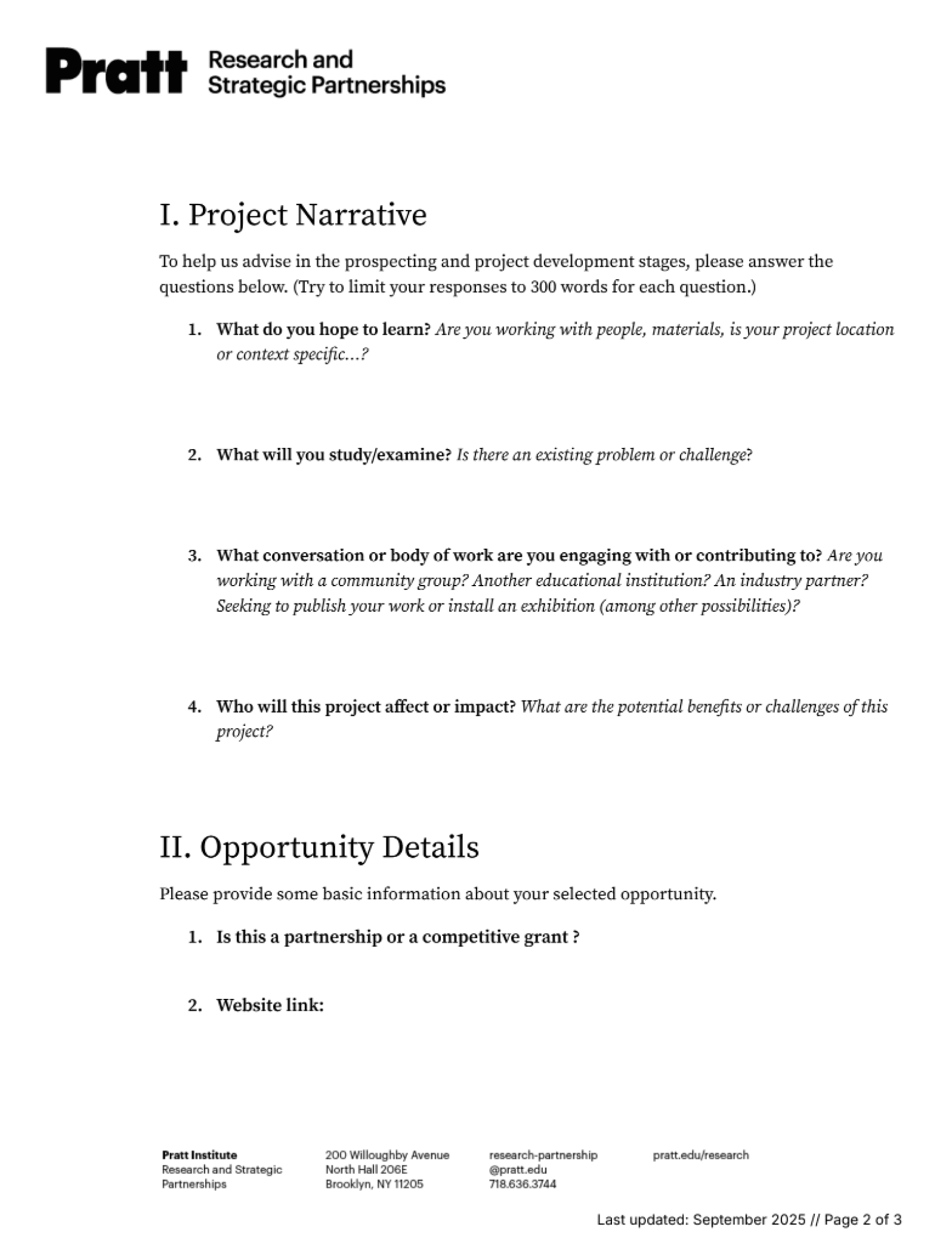
Simplified Project Discovery Google Form
Before
After

Transform a static google doc template into a accessible and interactive google form.
Event 2: IDC Accelerator Ambassadors - Departmental Research Showcase Series
A recurring or annual Research Showcase hosted within each department, where IDC Accelerator alumni present their research journey and outcomes.
Why this event matters?
Faculty feel overwhelmed by ORSP’s website and find it difficult to locate relevant information or resources.
Simplifies access to research support.
Reduces repetitive email inquiries and helps ORSP staff focus on higher-value support by directing faculty to the right tools or contacts from the start.
Connect to archetypes:
It primarily targets the New to Pratt and Research Newbie archetypes, as well as the Go-Getter archetype, who do not wish to spend excessive time on administrative tasks.
Project Outcome
Intervention 3: Regulated Appointment Scheduling & Faster Information Retrieval
What is it?
Insights Connection
How this intervention works?
01 Appointment Scheduling System

This scheduling system streamlines how faculty connect with ORSP by providing a clear entry point through the website and capturing key context upfront. By automatically routing requests to the appropriate staff member and handling confirmations through email, the system reduces back-and-forth communication, enables better-prepared consultations, and improves efficiency for both faculty and ORSP.
02 ORSP Virtual Assistant

The ORSP Virtual Assistant is a chatbot embedded in the ORSP website that provides faculty with a conversational way to access research support. Through simple prompts, the chatbot allows faculty to either retrieve relevant research information—such as guides, templates, and policies—or initiate meeting scheduling without navigating multiple pages. By combining instant information retrieval with an automated scheduling flow, the chatbot offers a low-friction entry point that helps faculty quickly reach the right resources or ORSP staff member with clarity and confidence.
Why this system matters?
Reduces friction through a clear, guided entry point
Minimizes back-and-forth by routing requests to the right ORSP staff
Provides faster access to accurate information
Improves efficiency and consistency for both faculty and ORSP
Connect to archetypes:
This intervention targets to all faculty archetypes.
Mapping a Bigger Picture
This Gantt chart presents a proposed project plan that the ORSP team can follow to implement all the proposed interventions.
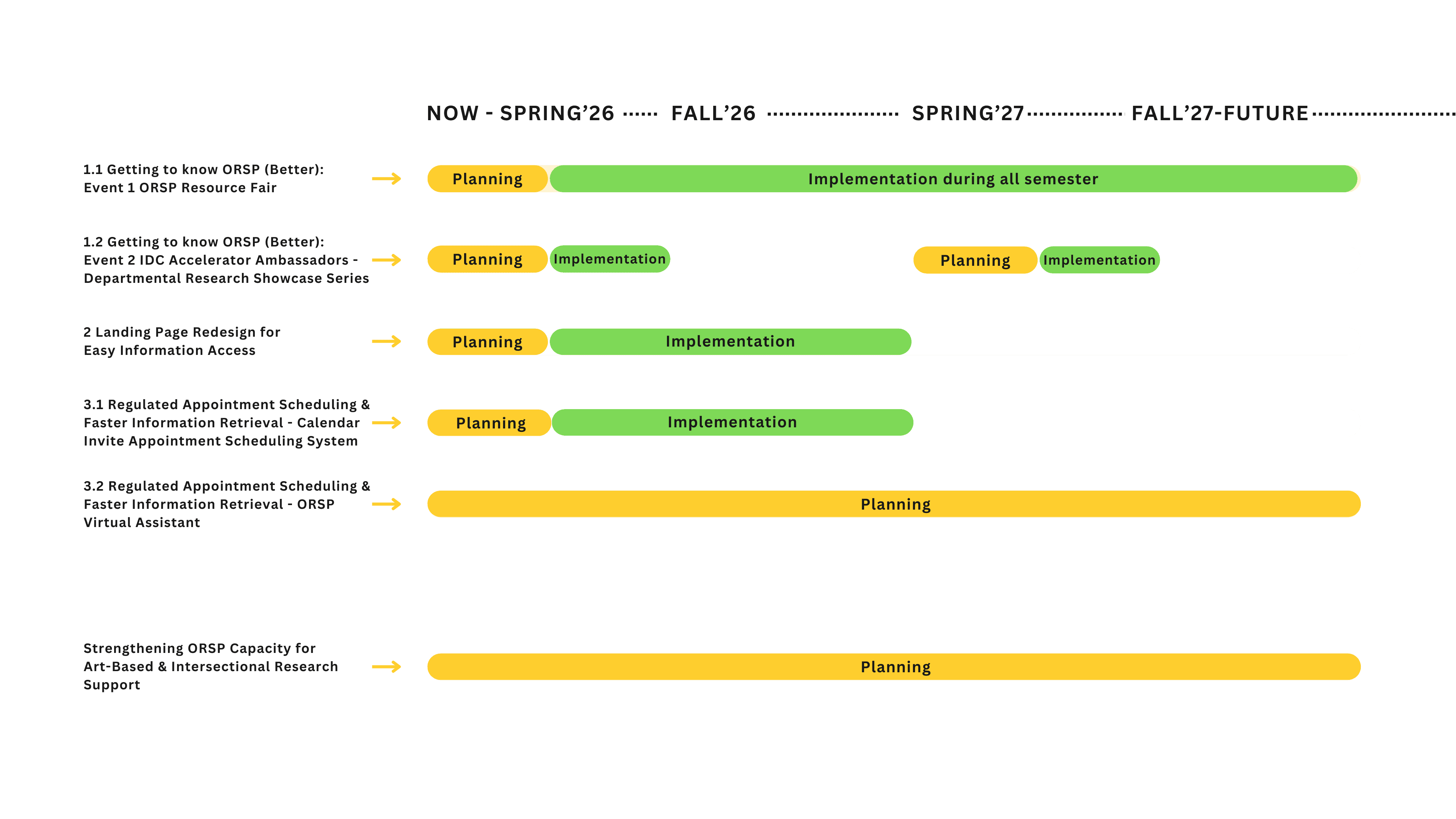
Future Plan Gantt Chart
Conclusion
Project Highlights-Client Presentation
My Key Takeaway
Project Highlights

Continue Exploring the ORSP